Better diagnostics for tremor and myoclonus
We are proud to share that an important new publication from the NEMO study (Next Move in Movement Disorders) has been published in Clinical Neurophysiology.
In this study, we investigated how artificial intelligence (machine learning) can help distinguish between essential tremor and cortical myoclonus. Although these conditions have different underlying causes and often require different treatments, they can sometimes appear remarkably similar during a clinical examination. Correctly identifying the underlying movement disorder is therefore of great importance.
Using electromyography (EMG) recordings from participants in the NEMO study, we analyzed patterns of muscle activity that are difficult to quantify by visual inspection alone. Our machine learning models were able to distinguish essential tremor from cortical myoclonus with high accuracy, achieving an AUROC of up to 0.93 in this study population.
The study also confirmed something that movement disorder specialists have long recognized in clinical neurophysiology: essential tremor is typically characterized by a regular, often alternating pattern of muscle activity, whereas cortical myoclonus shows a more irregular and synchronous activation pattern. Our findings now provide objective statistical evidence to support these clinical observations.
Why is this important?
For patients, an accurate diagnosis can make the difference between uncertainty and targeted treatment. For healthcare professionals, this study demonstrates how modern data science and clinical neurophysiology can complement each other. Ultimately, our goal is to support clinical expertise with objective measurement tools, helping patients receive the correct diagnosis more quickly.
International recognition
We are also pleased that this publication was accompanied by an editorial in the same issue of Clinical Neurophysiology. The editorial highlights our study as an important example of how machine learning can advance the field of movement disorder neurophysiology. At the same time, it emphasizes that careful validation and clinical expertise remain essential before such techniques can be widely implemented in routine clinical practice.
Thank you to all participants
These results were only possible thanks to the patients who took part in the NEMO study. Through their participation, they are directly contributing to the development of better diagnostic tools for people living with movement disorders, both now and in the future.
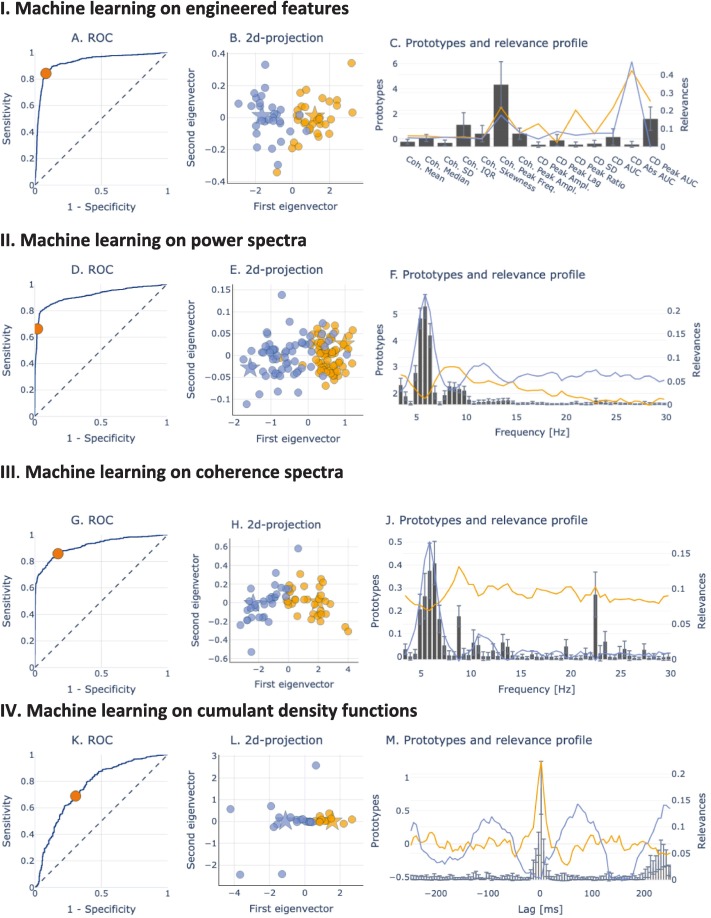
Figure from the publication. Using machine learning, patients with essential tremor (blue) and cortical myoclonus (orange) could be accurately distinguished based on EMG recordings. The different panels illustrate which signal characteristics were most informative for this classification.
Read the publication:
van den Brandhof EL et al. Machine learning based EMG analysis of intermuscular coherence and cumulant density in tremor and myoclonus. Clinical Neurophysiology (2026).
Read the accompanying editorial:
Grippe T. Machine learning-based diagnosis of movement disorders using clinical neurophysiology: are we ready? Clinical Neurophysiology (2026)