Watching, measuring and understanding: Marina de Koning-Tijssen on neurophysiology
In the most recent issue of Moving Along, Professor Marina de Koning-Tijssen was interviewed about a topic that closely reflects the daily practice of our expert centre: the role of clinical neurophysiology in movement disorders.
In the interview, Marina reflects on her personal career path, her fascination with the objective measurement of movement, and her firm belief that neurophysiology is an indispensable complement to careful clinical observation. This vision has long been an important pillar within Movement Disorders Groningen, where clinical care, neurophysiology, education and research are closely intertwined.
She discusses the added value of techniques such as polymyography in the evaluation of tremor, myoclonus and functional movement disorders, and explains how these measurements help to better understand, and ultimately treat, more complex clinical presentations. The examples she shares, in which neurophysiological assessment leads to a revised diagnosis or treatment strategy, will be familiar to all those working with these patients within our centre.
The interview also highlights training and mentorship, themes that play a central role in our centre’s approach. The enthusiasm for teaching, (inter)national courses and supervising early-career colleagues reflects how, in Groningen, we actively contribute to educating the next generation of movement-disorder neurologists.
Overall, the interview underscores what we stand for as an expert centre: careful phenomenology combined with objective measurements, aimed at improving diagnostic accuracy, enhancing patient understanding, and fostering ongoing innovation in the field.
The full interview with Marina can be read in Moving Along, the magazine of the International Parkinson and Movement Disorder Society
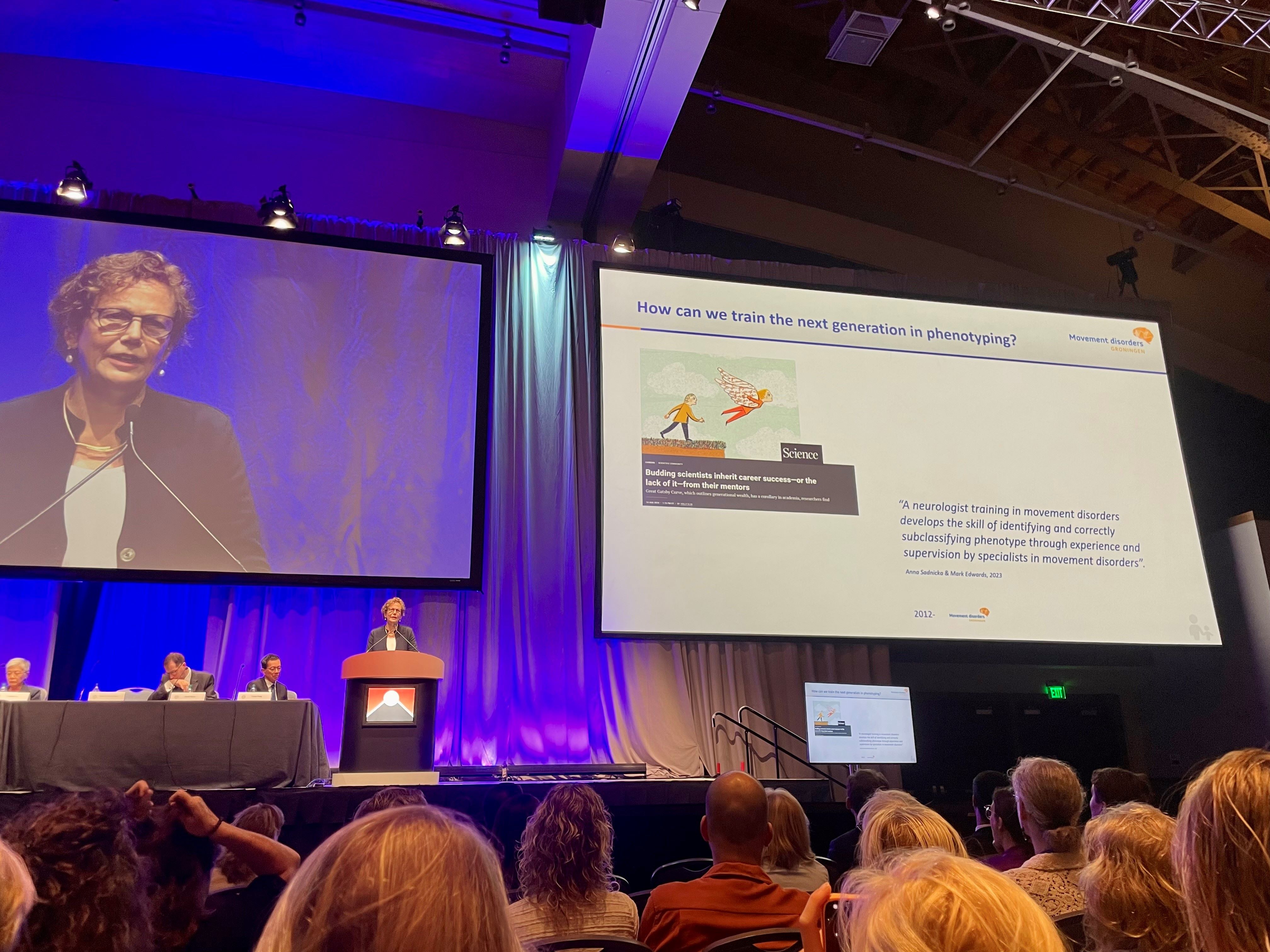
Marina de Koning-Tijssen delivers her Stanley Fahn Award Lecture during the congress of the International Parkinson and Movement Disorders Society in Philadelphia, 2024